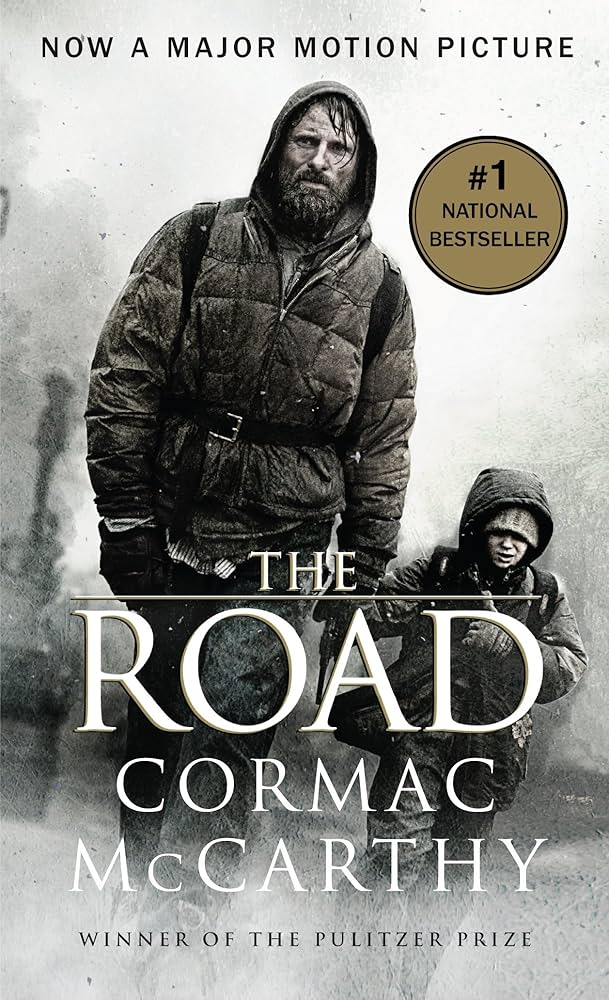
‘A father and his son travel through a dystopian America. Threatened by a ravaged landscape of ash and pollution, the pair are forced to defend themselves against the less humane beings that haunt their journey. Left with next to nothing: just a pistol, their clothes, a cart of scavenged food and their hope for a better future for the other, are all they have to survive off of.’
“Every day is a lie, he said. But you are dying. That is not a lie”
I was originally introduced to McCarthy’s ‘The Road’ for academic purposes but I can say with confidence that it is one of the most poignant dystopian novels of our time. Written in the aftermath of 9/11, McCarthy’s post apocalyptic world is undoubtedly one of the harshest settings for human survival, but against all odds our central characters, the boy and the man, survive by any means necessary.
‘The Road’ is not a moralistic story of hope, it is a book that demonstrates the raw reality of survival and expresses the extent to which mankind will go to stay alive.
Unlike many dystopian novels, ‘The Road’ offers no explanation for the condition of the Earth presented in the book and instead hones in on the intimate experience of a father and son who are trying to find a sense of security in a broken world. In particular, it is interesting to explore the noticeable decline in the boy’s naivety as he is increasingly exposed to the barbaric ways in which the other survivors continue to exist. Unable to protect his son from the hellish sights and situations of the post-apocalyptic world, the man instead focuses on driving his son onwards to the safety of the sea, forcing him to have no regard for the safety of any others.
McCarthy’s remarkable ability to deliver such a gut-wrenching storyline and form the character dynamic of a struggling father and hopeful son is highlighted by the simplistic prose, notably lacking speech marks, that effectively communicates all we need to know of our characters and their continual struggles. McCarthy’s writing raises questions surrounding the extent to which mankind will go to stay alive, resulting in the exploration of blurred lines of morality and the destabilisation of good and evil, as highlighted by the stark contrast of the man’s almost Nietzschean philosophy and the boy’s innocent wish to help all others.
‘The Road’ is perhaps considered a dystopian novel that is rooted in realism, offering insight into the very existence of humanity and questioning the morally ambiguous means by which it could survive when threatened by the extreme.
I would, undoubtedly, recommend this book to all and encourage discussion of the central themes that define it.
 TheFoxloreDiaries.UK
Leave a comment