From someone whose actually read it
Spoilers Ahead!
Christopher Nolan’s ‘The Odyssey’ is an adaptation of Homer’s infamous epic poem that recounts the trials and tribulations faced by the war-hero Odysseus on his 10 year voyage home following the siege and fall of the city of Troy. The almost 3 hour film features a star studded cast of well known actors and actresses to weave the journey of Odysseus into film.
Odysseus – “All the things you wanted to be and then all the things you wished you never wished for. It was a delicious itch you want to scratch but you find it under the skin and can’t reach it. So the delicious itch becomes unbearable. It told you what you most want is what you most can’t have and that the most you can’t have is what you already had and lost. It was a song of all the promises I failed to keep.”
To start I don’t think that adapting a piece of literature such as The Odyssey should ever be attempted purely because there are far too many elements, characters and storylines for a 2hr 30min to do justice to. That being said, as far as attempts go, considering Nolan’s budget for research this was far from a success.
I truly believe that Nolan wanted to create a film that had the setting and lore of Greek myth and ran with some of the books from The Odyssey as the baseline for his plot but from then on allowed the movie to become just that, a movie, not an adaptation. In fact, I think it would be a discredit to the original epic to call this movie ‘The Odyssey’. I am a firm believer that such a foundational piece of literature should never be watered down to better suit a target audience that enjoys the thrill of gore and war when that is meant to be the focus of The Iliad, not The Odyssey.
Ignoring the source material
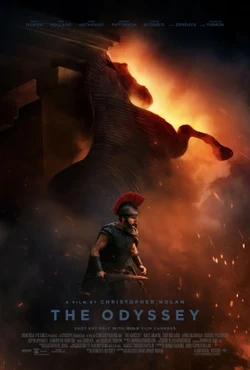
Despite having the budget to do so, the filmmakers evidently skipped out on some of the details needed to make this an accurate adaptation. The costuming, in particular the armour, of the film is a far cry from what would have actually been worn to battle and is instead replaced by Nolan’s decision to, somewhat stereotypically, create imagery of a battle between dark (the Achaeans) and white (The Trojans). Furthermore, the scenery of Ogygia (Calypso’s island) appears arid and exposed to the forces of nature when it is originally described as a lush paradise that is inhabited by an attractive Calypso in silver robes (not the sparse netting and almost worn white dress we see in the film).
The Odyssey’s central value of nostos (the perilous homecoming of war horror, to include survival and the restoration of honour and identity) was sacrificed by Nolan in order to have more screen time comprised of battle, going so far as to include, and end on, several sequences of the Trojan horse and the siege of Troy which is detailed in neither of the Homeric works (The Iliad or The Odyssey). The removal of nostos can be further noted in the erasure of Odysseus’ parents, as Laertes remains living in isolation in Ithaca being aged by his son’s disappearance before being released from the burden of grief by the revelation of Odysseus’ identity. Whereas Odysseus’ mother, Anticlea, has already succumbed to her grief and meets Odysseus in the Underworld and tells him of circumstances back in Ithaca, serving to further drive him in his motive for making it home to his family.
Why is it that Nolan remains so intent in ignoring his source material when he has several translations available to be drawn upon. Nolan, notably, removes several of the books from The Odyssey such as Aeolus and the bag of winds, and then misplaces elements of some books, such as the lotus flower of forgetfulness being utilised by Calypso rather than showcasing the lotus eaters as a separate event that affects only part of the ship’s crew (not including Odysseus). Ultimately, the removal of said events does make the movie jump from event to event, undermining the main theme of the storytelling of a tiresome and agonising journey home that keeps being derailed. Nolan also decides to rewrite common lore such as that of Xenia (showing hospitality to all guests) and replaces it with a tackier sounding ‘Zeus’ law’, which further tones down the influence of The Odyssey.
The Misrepresentation of Women
Moreover, Nolan ignores other key female characters such as Nausicaa (who offers support to Odysseus when he washes up on their shore) and, by extension, the existence of the entire Phaeacian court to whom Odysseus actually recounts his journey, as opposed to Calypso. Meanwhile Circe’s characters leans far too much into the stereotype of the old, haggard witch who has come to loathe the rest of society, as highlighted by the shack she inhabits. In the original texts and myth Circe is a goddess who lives in comparable grandeur, despite her expulsion to the island of Aeaea, and ends up looking after Odysseus and his crew for an entire year as they remain charmed by her charisma (a fact Nolan chose to ignore in his whistle stop store of the books of The Odyssey). In fact, Nolan also, in part, takes away from Calypso’s character by failing to explain the fate to which she is condemned (forced to stay on a remote island and continually fall in love with the mortal men who wash ashore who ultimately end up leaving her to continue their journeys). Similarly, another woman, Penelope, is misrepresented by this film with Hathaway presenting her as a somewhat whiny wife who succumbs to the injustice of not being able to sit on the throne. But Homer’s Penelope can match Odysseus wit for wit in her ability to strategise against the prying suitors so that she may remain loyal to her husband.
Lack of Divine Intervention
Another removal that is worth noting is that of divine intervention with Hermes helping hand in undoing the actions of Circe being non existent. But even more so I found myself rather frustrated with the reduction of Athene to a symbol of Odysseus’ conscience rather than the actual overpowering agent of aid that gets Odysseus safely home and reinstated as the king of Ithaca. Additionally, Nolan chose to represent the anger of Zeus, as handed to him by Helios (not Apollo!!) at the slaughter of his cattle, and Poseidon through sequences on the ship rather than an physical presences. However, this does arguably make for some impressive cinematography.
Odysseus’ Character
I think one of the most frustrating elements that Nolan got wrong was the presentation of Odysseus himself. Odysseus, above all, values his family and all the actions he undertakes are made in effort of getting home. Despite the natural charm and physical presence of some of the women Odysseus encounters he outright refuses to remain out of his need to fulfil the position of being Penelope’s husband and Telemachus’ father, so much so that throughout the Iliad his self imposed epithet of being father of Telemachus as one of central characteristics, demonstrating the significance with which he regards his family back home. But this is contrasted by Nolan’s choice to have Odysseus suffer an amnesia that essentially acts a blockage to remembering his sole purpose of journeying back home, the purpose of the Odyssey. Furthermore, Odysseus’ greatest asset, and perhaps weapon, is his intelligence and innovation, as noted by the common epithet of ‘wily (uses their ability to deceive and scheme, and cunning to achieve their aims) Odysseus’. However, by the removal of Odysseus’ famous trick of telling Polyphemus (the Cyclops) his name is ‘Nobody’ allows him to temporarily avoid the consequences of harming Poseidon’s son before his egoistical mistake of exclaiming his name to Polyphemus when sailing away, allowing Polyphemus to pray to Poseidon to bring misfortune to Odysseus’ and his crews journey. By the removal of Odysseus’ deceit and hubris, Nolan presents Poseidon as an omniscient being who already knows who Odysseus is, in order to enact his punishment. Instead, Nolan is forced to give an unnecessary amount of screen time to the plan surrounding the Trojan horse so he can show Odysseus’ intellect. Not only this, but Odysseus’ character remains indistinctly unbalanced in the fact he is shown to be both morally grey and guilt burdened but only selectively shows either extremity depending on the scene. However, an Odysseus who shows mercy to the suitors (who dared mistreat his wife) but degrades the actions of his comrades in favour of disregarding burial rites (which Homer’s Odysseus valued) is not an accurate representation of Odysseus nor an adaptation to his character that I can get on board with.
Credits to Nolan
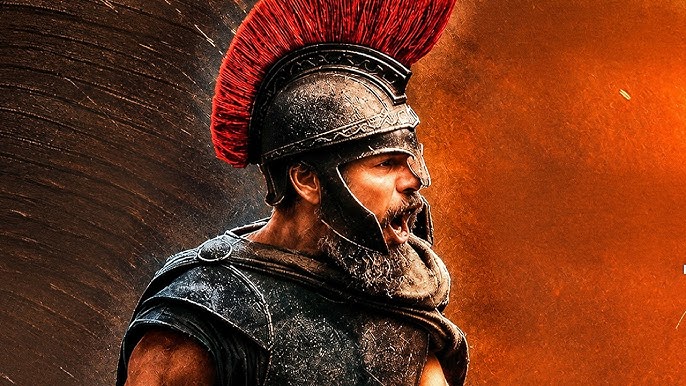
On the other hand, I’ve got to hand it to Nolan and John Leguizamo for their presentation of Eumaeus (Odysseus’ loyal swineherd). While Nolan may not have made a good adaptation he sure does know how to make a good film, from the guttural scream of the Cyclops to the cinematography and lighting of the storm the ship faces, which makes for a particularly engaging IMAX experience. Moreover, the ingenuity of the score when lining up alongside the scenes, for example the stringing and pluck of the bow makes the film all the more engaging so while I do not find myself agreeing with the way Nolan presented The Odyssey, that does not necessarily mean I didn’t enjoy it as an intriguing and unique cinematic experience.
 TheFoxloreDiaries.UK
Leave a comment